

Why this project matters
Waste management challenges do not stop at borders. In the Pécs-Osijek region, the project used cross-border cooperation to examine how neighbouring areas could learn from each other and jointly improve waste management practices. This was important because circular economy and bio-waste solutions require both professional coordination and citizen participation. The project went beyond a one-off awareness campaign by combining household-level tools, stakeholder exchange and strategic guidance that can inform similar initiatives elsewhere.
Capitalisation
Capacity building relevant
The project strengthened the capacities of waste management organisations and local communities through professional exchange, workshops and citizen education. At least 250 people received training on separate waste collection and composting.
Scalable / Replicable model
The project combined household bio-waste infrastructure, citizen engagement and joint professional guidance in a model that can inform similar initiatives in other municipalities and cross-border regions. It also continued in two further joint projects – see “Project afterlife” below for details.
Project type
Last Mile projects
The project translated circular economy objectives into practical local action by distributing 3,617 bio-waste bins and home composters, and providing composting guidance to more than 2,400 residents.
Achievements
The project combined practical household support, citizen education, professional exchange and joint planning to improve bio-waste management in Pécs and Osijek.
- Bio-waste collection improved: A total of 3,617 bio-waste bins were distributed to households in the two cities, providing residents with practical infrastructure for separating and composting organic waste.
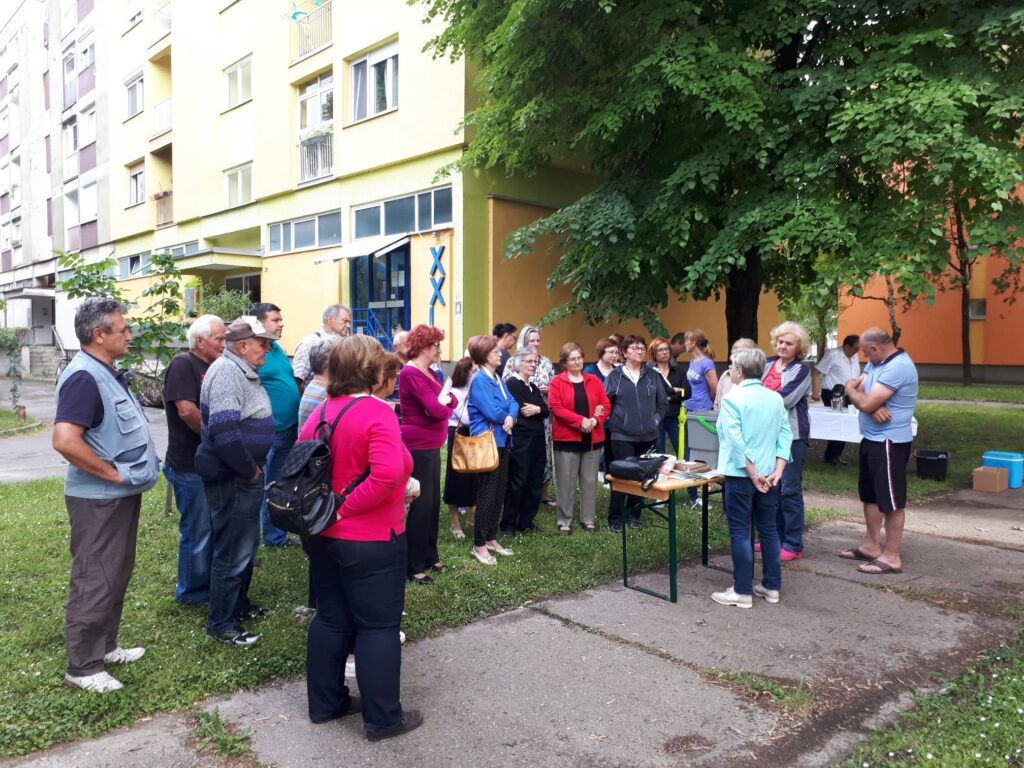
- Residents received practical guidance: At least 250 people took part in training on separate waste collection and composting, while more than 2,400 households received home-composting guidance.
- Waste-management professionals exchanged knowledge: Networking events and a study tour connected organisations from both sides of the border and supported shared learning on circular-economy practices.
- Joint guidance was developed: The project analysed waste management in the border region and produced guidelines with recommendations on circular-economy development and potential cross-border cooperation.
- Cooperation between key organisations was strengthened: Waste-management companies and regional-development organisations from Hungary and Croatia worked together on practical and strategic responses to shared waste-management challenges.
What can be reused
The main transferable value of 2Regions2Sustain lies in the combination of concrete household-level outputs, professional cooperation and strategic guidance. Other regions can use the project as a model for linking citizen engagement with more coordinated waste management planning.
Reusable resources
1. Home composting guide (Hungarian)
2. Composting Handbook (Croatian)
3. Project leaflet
A short overview of the project goals, activities and results, including the breakdown of the bio-waste bins and home composters.
4. Study “Development of Waste Management Systems in View of the Circular Economy – Study on the Opportunities for Further Cooperation Between Hungary and Croatia”
Reusable concepts
- Helping households separate bio-waste: Practical equipment, clear guidance and awareness-raising activities make separate collection and home composting easier for residents.
- Learning from practices across the border: Networking events and study visits allow waste-management professionals to compare experiences and identify opportunities for cooperation.
- Connecting different areas of expertise: Waste-management companies, urban-development organisations and regional-development agencies work together, linking practical experience with longer-term planning.
- Connecting local action with wider waste-management goals: Household bio-waste collection and composting activities contribute to broader circular-economy and cross-border waste-management objectives.
Project afterlife
2Regions2Sustain is the second in a series of four Interreg projects led by Unikom with partners from Pécs, each building on earlier results:
- REGION2SUSTAIN established the first joint framework for cross-border waste management between Osijek and Pécs.
- 2Regions2Sustain brought this cooperation to households through bio-waste bins, home composting, citizen education, a joint study and an agreement between the two waste-management companies.
- 2RegionsZOOSustain expanded the partnership into waste-to-energy, renewable energy and environmental education at the zoos in Osijek and Pécs. Its renewable-energy study also supported the preparation of a biomass-heating investment.
- Smarter ZOOs now takes the concept into implementation through biomass heating at Osijek Zoo and solar-power and energy-efficiency investments at Pécs Zoo.
Together, the four projects show how a long-term cross-border partnership progressed from joint planning to household action, education, renewable-energy development and physical investment.